The future of work is rapidly changing due to artificial intelligence and automation. As businesses across the world adopt AI-powered tools, the skills needed in the AI era are becoming more important than ever. Traditional jobs are evolving, new roles are emerging, and professionals must adapt to stay relevant. Understanding the future of work and the essential skills required in the AI era is no longer optional—it is critical for career growth and long-term success.
The future of work is not about humans versus machines. Instead, it is about humans working alongside intelligent systems. Those who adapt and upgrade their skills will thrive. Those who resist change may struggle to stay rel
How AI Is Transforming the World of Work
Artificial Intelligence is no longer limited to research labs or tech giants. Today, AI is used in:
- Customer support (chatbots, virtual assistants)
- Marketing (content creation, ad optimization, analytics)
- Healthcare (diagnostics, predictive analysis)
- Finance (fraud detection, algorithmic trading)
- Education (personalized learning systems)
- Manufacturing (robots, predictive maintenance)
According to global studies, millions of jobs will be automated—but at the same time, millions of new jobs will be created. The key difference lies in the skills required.
The future workforce will need a mix of technical skills, human skills, and adaptive abilities.

The Shift from Degrees to Skills
One of the biggest changes in the AI era is the declining importance of traditional degrees alone. Employers now prioritize:
- What you can do
- How quickly you can learn
- How well you adapt to change
Skills-based hiring is becoming the norm. Continuous learning is no longer optional—it’s essential.
Core Skills Needed in the AI Era
Let’s break down the most important skill categories that will define the future of work.
1. AI Literacy (Understanding How AI Works)
You don’t need to be a data scientist to succeed in the AI era—but you must understand AI basics.
Why AI Literacy Matters
- Helps you work efficiently with AI tools
- Enables better decision-making
- Reduces fear of automation
- Improves productivity
Key Concepts to Understand
- What AI and machine learning are
- How algorithms make decisions
- Bias in AI systems
- Ethical implications of AI
Professionals who understand AI will outperform those who ignore it—even in non-technical roles.
2. Digital & Technical Skills
As work becomes more digital, technical skills are increasingly valuable across industries.
High-Demand Technical Skills
- Data analysis & data literacy
- Cloud computing basics
- Cybersecurity awareness
- Automation tools (Zapier, Power Automate)
- No-code and low-code platforms
- AI tools like ChatGPT, Copilot, Midjourney
You don’t need to code complex software, but basic technical fluency will soon be as important as reading and writing.
3. Data Literacy & Analytical Thinking
Data is the fuel of the AI economy. Companies rely on data to make decisions, predict trends, and personalize experiences.
Data Skills for the Future
- Understanding charts, dashboards, and metrics
- Interpreting insights from data
- Asking the right questions
- Making data-driven decisions
Even marketers, HR professionals, and managers are expected to be data-literate in the AI era.
4. Critical Thinking & Problem-Solving
AI can process data faster than humans—but it still struggles with complex reasoning, context, and judgment.
Why Critical Thinking Is Future-Proof
- Helps solve non-standard problems
- Allows humans to question AI outputs
- Prevents blind reliance on automation
- Enables better strategic decisions
In the future, humans won’t be valued for routine tasks—but for thinking, reasoning, and problem-solving.
5. Creativity & Innovation
Contrary to popular belief, AI does not replace creativity—it enhances it.
Creativity Skills in Demand
- Creative thinking
- Content creation
- Design thinking
- Innovation strategy
- Idea generation
AI can generate ideas, but humans decide what matters, what resonates, and what creates emotional impact.
Creativity combined with AI tools is a powerful career advantage.
6. Communication & Storytelling Skills
As technology becomes more complex, the ability to explain ideas simply becomes more valuable.
Future-Ready Communication Skills
- Clear written communication
- Presentation skills
- Storytelling with data
- Persuasion and negotiation
- Cross-cultural communication
People who can communicate effectively will lead teams, influence decisions, and build trust in the AI era.
7. Emotional Intelligence (EQ)
AI lacks empathy. Humans don’t.
Emotional intelligence will be one of the most important skills of the future.
Key EQ Skills
- Self-awareness
- Empathy
- Active listening
- Conflict resolution
- Leadership and people management
Jobs involving people—coaching, leadership, sales, healthcare, education—will rely heavily on emotional intelligence.
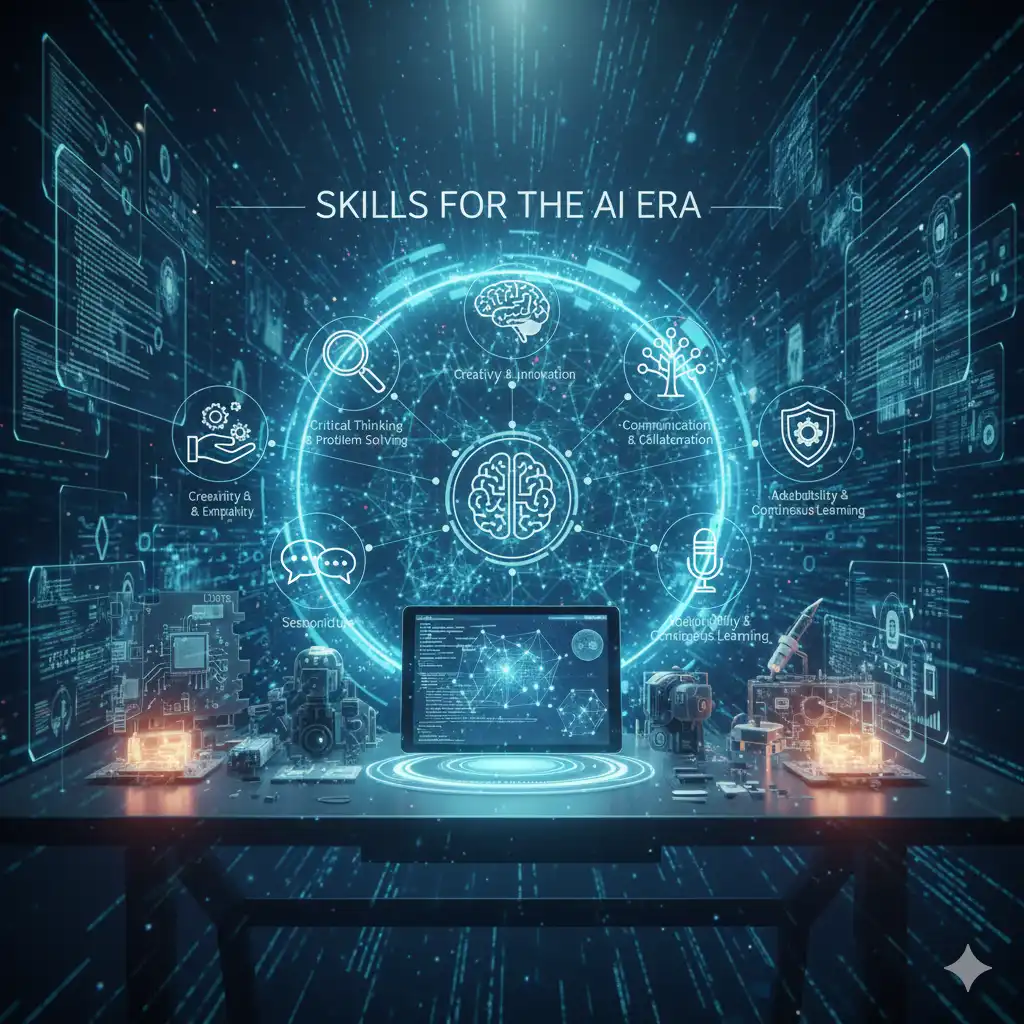
8. Adaptability & Lifelong Learning
The AI era rewards those who learn continuously.
Why Adaptability Is Essential
- Job roles change rapidly
- New tools emerge constantly
- Skills become outdated quickly
Future professionals must be comfortable with:
- Learning new tools
- Reskilling and upskilling
- Reinventing themselves multiple times
Those who embrace change will always find opportunities.
9. Prompt Engineering & AI Collaboration
A new skill is emerging: knowing how to work with AI effectively.
What Is Prompt Engineering?
It’s the ability to give clear, structured instructions to AI tools to get the best results.
Why It Matters
- Increases productivity
- Improves AI output quality
- Saves time
- Enhances creativity
In many roles, knowing how to ask the right questions will be more important than knowing all the answers.
10. Ethical Thinking & AI Governance
As AI becomes more powerful, ethical concerns grow.
Ethical Skills Needed
- Understanding AI bias
- Responsible AI usage
- Data privacy awareness
- Transparency and accountability
Organizations will need professionals who can ensure AI is used responsibly and fairly.
Jobs That Will Thrive in the AI Era
AI will not eliminate work—it will transform it.
Growing Career Areas
- AI trainers and prompt engineers
- Data analysts
- Digital marketers
- UX/UI designers
- Cybersecurity professionals
- Product managers
- Human-AI interaction specialists
- Content creators using AI
Hybrid roles combining human skills + AI tools will dominate the job market.
How to Prepare for the Future of Work
Here’s how you can start today:
Steps to Future-Proof Your Career
- Learn AI basics
- Build digital and data skills
- Practice critical thinking
- Improve communication
- Use AI tools daily
- Invest in emotional intelligence
- Commit to lifelong learning
You don’t need to master everything—just stay curious and consistent with skills needed in the AI era.
The Role of Education in the AI Era
Education systems are also evolving.
Future education will focus on:
- Skills, not memorization
- Practical learning
- Interdisciplinary knowledge
- Continuous upskilling
Online learning, micro-credentials, and skill-based certifications will become mainstream.
Final Thoughts: Humans Still Matter in the AI Era
The future of work is not about replacing humans with machines. It’s about augmenting human potential with AI as well as skills needed in the AI era.
AI will handle:
- Repetitive tasks
- Data processing
- Automation
Humans will handle:
- Creativity
- Ethics
- Strategy
- Empathy
- Leadership
Those who develop the right skills will not just survive—but thrive in the AI era.